Candidates for Removal from Scopus: Second Edition

My name is Vasyl Malets — Director of Futurity Publishing and an expert in scientometrics.
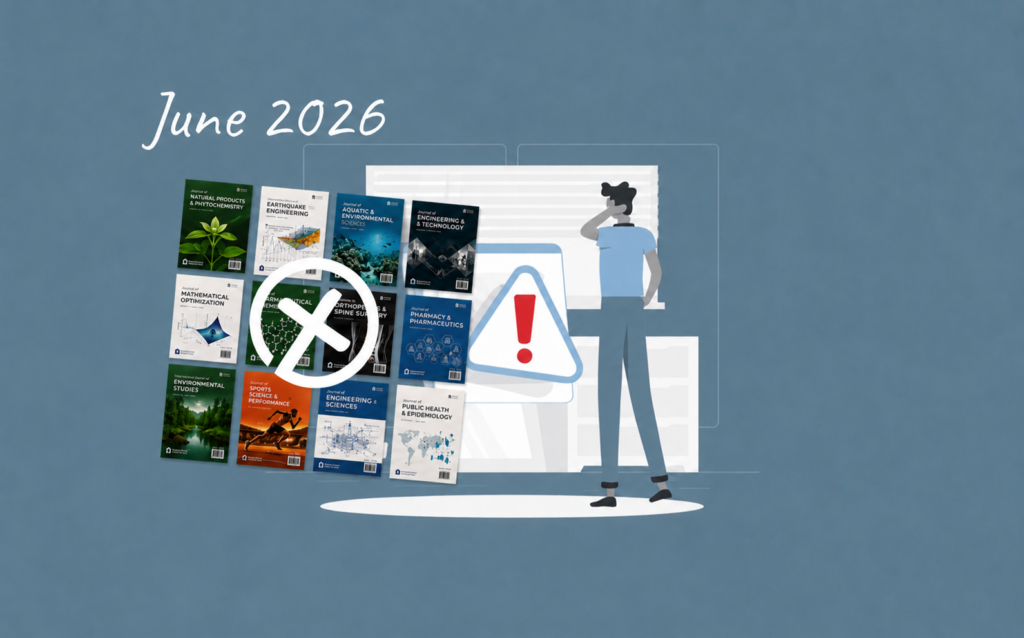
In this edition, we review five new journals currently at high risk of being removed from Scopus — including three Q2 journals and three from EU countries.
Once considered reliable platforms for academic publishing, these journals now demonstrate clear signs of losing academic integrity:
📉 a sharp decline in citation metrics,
📊 low article quality,
💰 questionable editorial policies.
This once again proves that even Q2 journals and those from EU countries are not immune to removal from Scopus if they ignore academic ethics and quality control standards.
List of journals
E-ISSN: 2184-8645
🔗 Scopus link: https://www.scopus.com/sourceid/21101247624
🔗 Journal website: https://journals.ap2.pt/index.php/ais
Overview:
Architectural Image Studies was accepted into Scopus in 2024 and initially positioned itself as a specialized journal in architecture and design. However, since August 2025, it has drastically changed its editorial strategy: mass submission invitations began circulating, and the journal started describing itself as “multidisciplinary.”
This raised serious concerns within the academic community — since, even from its title, it’s evident that the journal should remain narrow in scope.
Within a short time, a large number of unrelated papers were published, many having no connection to architecture or design. This is a typical sign of journals that have shifted from academic quality to a commercial model without proper peer review.
Journal Profile:
Quartile: Q4
Country: Sweden
Field: Architecture, Design
Publication Fee: 500 USD
Main Violations:
Publishing papers unrelated to the stated focus area.
Absence of proper peer review.
Rapid growth in publication volume within a short period.
Mass email invitations to authors.
Current Status:
The journal is currently under review by the Scopus Content Selection & Advisory Board (CSAB). Recent issues have raised strong suspicions regarding breaches of quality and ethical standards.
Risk Assessment:
Probability of removal from Scopus: 100%
Probability that new articles won’t be indexed: 100%
E-ISSN: 2589-1316
🔗 Scopus link: https://www.scopus.com/sourceid/21101151828
🔗 Journal website: https://jcasc.com/index.php/jcasc
Overview:
The Journal of Cultural Analysis and Social Change had long maintained a strong reputation and was considered a quality publication in sociology and cultural studies. However, in the second half of 2025, the editorial office began sending mass invitations for publication, offering “fast-track” publishing for 1,200 USD.
At first glance, the website appears normal — the structure and archive look legitimate. But during communication with the editorial team, we found that the journal had significantly changed its scope, turning into an “everything about everything” platform — a clear indicator of a predatory transition.
The most concerning fact is that the journal hasn’t yet started mass publishing but is actively collecting manuscripts to release a single, massive issue with hundreds of papers at once — a typical sign of a “young” predatory journal preparing for monetization.
Journal Profile:
Quartile: Q2
Country: Netherlands
Field: Sociology, Cultural Studies, Interdisciplinary Research
Publication Fee: 1,200 USD
Main Violations:
Mass email campaigns offering quick publication.
Acceptance of papers without proper peer review.
Changing the journal’s scope to “multidisciplinary” without notifying Scopus.
Preparing for mass publication of low-quality papers.
Current Status:
The journal remains active and continues to publish, but it’s now in Scopus’s “gray zone” of monitoring. Once it attempts large-scale releases, Scopus will likely initiate a CSAB review.
Risk Assessment:
Probability of removal from Scopus: 100%
Probability of future article deindexing: 100% (if large volumes of low-quality papers are published).
ISSN: 2179-8699
🔗 Scopus link: https://www.scopus.com/sourceid/21100845376
🔗 Journal website: https://revista.domhelder.edu.br/index.php/veredas
Overview:
Veredas do Direito had long enjoyed a solid academic reputation, being stably indexed in both Scopus and Web of Science, and publishing high-quality papers exclusively in the field of law. It was one of the few Brazilian journals combining dual indexing with a narrow specialization, making it highly trusted among researchers.
However, over the last two to three months, the situation has changed dramatically. The editorial board began publishing papers on topics far beyond the legal field — from architecture and art to medicine and artificial intelligence.
A journal that previously released just one issue per year has now produced three consecutive issues, publishing over 150 papers — more than in the previous five years combined. This is a textbook example of losing editorial control and shifting to a commercial publishing model.
Journal Profile:
Quartile: Q4
Country: Brazil
Field: Law
Publication Fee: 750 USD
Main Violations:
Publishing articles outside the journal’s scope.
Rapid increase in the number of issues and articles.
Absence of proper peer review.
Irregular publication schedule.
Current Status:
The journal remains indexed in both Scopus and Web of Science, but recent issues have raised serious concerns in the academic community and could trigger CSAB monitoring.
Risk Assessment:
Probability of removal from both Scopus and Web of Science: 100%
Probability of deindexing recent articles: very high (90–100%)
ISSN: 1311-1728
E-ISSN: 1314-8060
🔗 Scopus link: https://www.scopus.com/sourceid/21100841738
🔗 Journal website: https://ijamjournal.org/ijam/contents/index.html
Overview:
The International Journal of Applied Mathematics (IJAM) — a Q2 publication — has for many years focused on applied mathematics and related disciplines. However, in 2025, it began showing clear signs of quality degradation.
Instead of maintaining a stable publication policy, IJAM drastically increased its number of papers, launched numerous special issues, and shortened publication timelines to just 15 days between submission and publication — a clear sign of the absence of peer review.
While the topics still formally align with the journal’s declared focus, the quality of the papers is alarmingly low — mostly compilations with no originality or novelty.
Journal Profile:
Quartile: Q2
Country: Bulgaria
Field: Applied Mathematics, Physics, Engineering, Programming
Publication Fee: 900 USD (standard) / 1,500 USD (fast publication)
Main Violations:
Rapid growth in article volume and special issues.
Unrealistically fast publication times (15 days).
Lack of genuine peer review.
Extremely low scientific quality.
Current Status:
The journal remains indexed in Scopus but is already under observation by CSAB and may soon be subject to a full review.
Risk Assessment:
Probability of removal from Scopus: 95%
Probability of article deindexing: 50% (as the topic remains within the stated scope).
ISSN: 2516-3299 | E-ISSN: 2516-3302
🔗 Scopus link: https://www.scopus.com/sourceid/21100978041
🔗 Journal website: https://verjournal.com/index.php/ver/about
Overview:
Vascular and Endovascular Review was long considered a reputable medical journal specializing in vascular and endovascular surgery. Until 2024, it consistently released two issues per year with no more than 20 papers annually.
However, in 2025, the journal underwent drastic changes — most likely being sold to new owners pursuing commercial objectives. Within one year, VER released six issues, four of which were special editions, and published over 250 papers — more than 10 times its usual output.
Articles now appear less than 10 days after submission, indicating no peer review at all. Moreover, the journal has begun publishing papers unrelated to vascular medicine — a typical symptom of a predatory transition.
Journal Profile:
Quartile: Q2
Country: Afghanistan
Field: Vascular Surgery, Cardiology, Medicine
Publication Fee: 1,500 USD
Main Violations:
Tenfold increase in publication volume.
Excessive number of special issues.
Publishing papers outside the journal’s focus.
Extremely fast publication times (under 10 days).
Current Status:
The journal is currently under review by CSAB (Scopus Content Selection & Advisory Board). Out of around 250 papers published in 2025, only 63 have been indexed, while the remaining ones will likely be excluded.
Risk Assessment:
Probability of removal from Scopus: 100%
Probability of deindexing already published papers: 50% (some may remain in the database).
🛡️ How to Protect Your Publications
Publishing in Scopus is not only about prestige but also about your invested money, time, and reputation.
Unfortunately, no journal can guarantee absolute indexing stability.
That’s why it is important to work with experts who thoroughly verify each journal before submission and provide guarantees for article indexing.
Need a publication in Scopus or Web of Science — without risk or stress?
Order “Journal Selection & Submission Support” from Futurity Publishing.
We will handle the entire process for you:
from verifying and selecting a reliable journal for your topic — to the final publication of your article.
No predatory journals, no delays, no loss of indexing.
📩 Submit your request — and we will find the perfect journal for you today.
Conclusion
In this edition, we reviewed five journals, including three from the second quartile (Q2) and three based in EU countries.
As practice shows, even a prestigious quartile or a “European affiliation” does not guarantee academic integrity. Many journals that once held impeccable reputations are now deliberately prioritizing quick profit over scholarly standards.
Unfortunately, researchers without daily experience in publication analysis fall into predatory traps in over 70% of cases.
Fast publication may seem like an attractive opportunity — but the outcome is often the same: lost money, lost time, and lost reputation.
That’s why Futurity Publishing strongly recommends working only with verified experts who provide real guarantees of publication and indexing in Scopus, Web of Science, and other reputable databases.
The temptation of a quick publication is strong — but always consider the consequences. The losses after a wrong choice can be far greater.
This was Vasyl Malets
Scientometrics expert and founder of Futurity Research Publishing.
Follow me on LinkedIn
You’ll find even more valuable insights about academic journals and publications there.