What Really Affects Your h-Index — and What Doesn’t

You’ve been publishing for years, yet your h-index won’t budge? The problem is rarely the quality of your research — it’salmost always the strategy.
What the h-index actually measures
Physicist Jorge Hirsch introduced this metric in 2005 to simultaneously capture a researcher’s productivity and scientific impact. The formula is straightforward: a scientist has an h-index of h if exactly h of their papers have each been cited at least h times. Once a paper enters the ‘h-core’, further growth in its citation count no longer raises your index.
The key trap: most researchers try to maximise total citations or total publications — but the h-index only grows when new papers cross the current threshold. A researcher with 10 papers at 10 citations each and a researcher with 10 papers at 100 citations each have exactly the same h-index of 10.
WHAT ACTUALLY WORKS
7 factors that move the h-index
1. Even distribution of citations across papers
Lifting papers toward the threshold is more effective than piling citations onto your already-leading work
The h-index depends on how many papers simultaneously clear the threshold — not on having one blockbuster. Focus on papers that are 2–5 citations short of the threshold, rather than adding more citations to papers already well above it.
2. Publishing review and methods articles
Reviews are cited on average 2.95× more often — in some fields up to 6×
If 20% of your portfolio consists of reviews, your average citation count can increase by 40–80%. A well-placed methods paper works similarly: a novel technique gets cited in virtually every subsequent paper in your niche.
3. Open Access publication
Analysis of 19 million papers (2010–2019): OA consistently outperforms paywalled articles — up to 7×
The logic is simple: if a researcher cannot download your paper, they cannot cite it. Open Access removes that barrier for researchers at under-resourced institutions and in lower-income countries.
4. Preprints (arXiv, bioRxiv, SSRN)
+36% more citations and +49% more attention (Altmetric score) compared to papers without preprints
A preprint gives your work a head start — it becomes visible and citable before the journal version is published. For STEM researchers, posting to arXiv, bioRxiv, or SSRN is essentially a free insurance policy against lost citations.
5. International co-authorship
Analysis of 50 leading universities: direct correlation between international collaboration and weighted citation index
More co-authors from different countries means a wider network of potential readers and citers. Every collaborator shares the paper within their own scholarly community.
6. Keyword optimisation and trending topics
A paper in a relevant, timely topic gets cited organically — people are reading it and referencing it right now
Align terminology across your title, abstract, and keywords field. Add synonyms of key terms in different sections. Separately: track topics gaining momentum in your field — AI in medicine, climate adaptation, multi-omics, etc. Publishing in a trending niche generates natural citation growth because new papers inevitably reference prior work in that area.
7. Digital profile and discoverability
Researchers who are easy to find get cited more often
A configured Google Scholar profile automatically tracks citations and displays your h-index publicly. ORCID iD resolves name-disambiguation issues and is required by many publishers and funders. ResearchGate and Academia.edu increase full-text availability.
Most researchers read useful articles and forget 80% of the information within a week.
Turn knowledge into real action. 📲 Download «5 Strategies to Boost Your h-Index 90% More Effectively», open it on your screen and start ticking off completed items today.
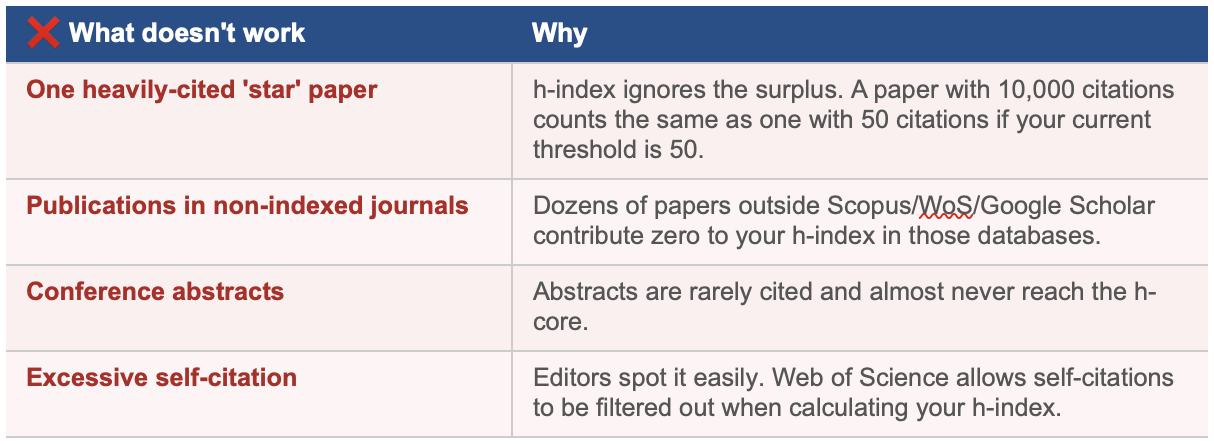
WHAT DOESN'T WORK
Stop doing these things for the sake of your h-index
Field matters: in clinical medicine a ‘good’ h-index is around 84; in mathematics it’s around 19. Only compare your h-index to colleagues in the same field with a similar career length.
CONCLUSION
Good science and cited science are not the same thing
The h-index is one of the most influential scientometric metrics used by universities, funding bodies, and hiring committees worldwide. Like any tool, it measures one specific thing: the ability of your work to be found, accessed, and considered relevant by peers.
The good news: these factors are all within your strategic control. A researcher who understands the mechanics has a real advantage.
The real strategy is a systematic approach
Build a visible, accessible, and well-structured academic profile: open access, preprints, international partnerships, review articles, trending topics, and the right keywords.
These are the factors that turn good science into cited science. And cited science is an h-index that keeps moving.
Want to grow your h-index?
A personalised strategy, journal matching, and citation partnership programme — for researchers ready to take a systematic approach.