Excluded Journals from Scopus: February 2026

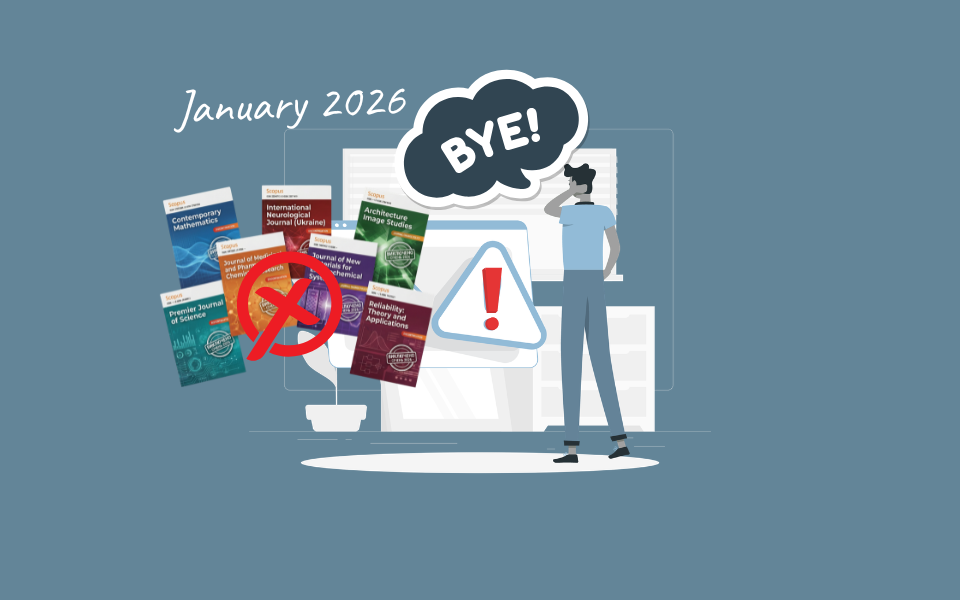
Scopus has published its February 2026 database update — and this time, 7 journals have lost their indexing.
What stands out immediately: six out of seven were removed due to Discontinuation — meaning the journals simply ceased to exist. No high-profile scandals, no lengthy CSAB reviews, no public warnings. They were active — and then they were gone.
This is precisely what makes Discontinuation the most dangerous type of removal for authors. A journal flagged for Journal Change Policy usually ends up on the radar — it gets discussed, warnings circulate. But Discontinuation happens quietly: a journal accepts submissions one day, and the next it’s no longer in the database — while authors find out only after submitting their work.
This month’s removed journals span education, economics, mathematics, mining engineering, and perinatal medicine — covering a wide range of research fields and geographies.
Official List of Removed Journals (February 2026)
- ISSN: 2147-0901
- E-ISSN: 2564-8020
- Publisher: Universitepark
- Reason: Discontinuation
- Scopus profile: View in Scopus
- Journal website: edupij.com
- ISSN: 2306-4994
- E-ISSN: 2310-8770
- Publisher: Fintech Alliance LLC
- Reason: Discontinuation
- Scopus profile: View in Scopus
- E-ISSN: 2309-4508
- Publisher: Science Publishing Corporation Inc.
- Reason: Discontinuation
- Scopus profile: View in Scopus
- E-ISSN: 2146-4553
- Publisher: Econjournals
- Reason: Discontinuation
- Scopus profile: View in Scopus
- ISSN: 2008-949X
- Publisher: International Scientific Research Publications
- Reason: Discontinuation
- Scopus profile: View in Scopus
- ISSN: 0022-2755
- Publisher: Informatics Publishing Limited
- Reason: Discontinuation
- Scopus profile: View in Scopus
- E-ISSN: 1305-3124
- Publisher: Perinatal Medicine Foundation
- Reason: Journal Change Policy
- Scopus profile: View in Scopus
🔒 Don't submit before checking your journal
This month’s removals happened without any prior warning.
Use our free 7-point Red Flags Checklist to verify any journal in under 5 minutes — before it’s too late.
Conclusion
The February 2026 Scopus update is not an anomaly — it is part of the regular rhythm every researcher publishing internationally must account for.
Six journals ceased to exist (Discontinuation), and one changed its editorial policy to such a degree that Scopus could no longer confirm compliance with its standards. The affected fields range from economics and finance to education, mathematics, medicine, and mining.
What this means in practice for every author:
- A paper submitted or accepted before removal risks not being credited during evaluation or degree defence;
- Months — sometimes years — of work can be invalidated by a single journal’s loss of indexing;
- Grant reporting and academic promotion requirements tied to Scopus publications may be left unfulfilled.
The February update makes one thing clear: verifying a journal before submission is not optional caution — it is a necessary step. In today’s academic environment, the researchers who make decisions based on data, not assumptions, are the ones who stay protected.