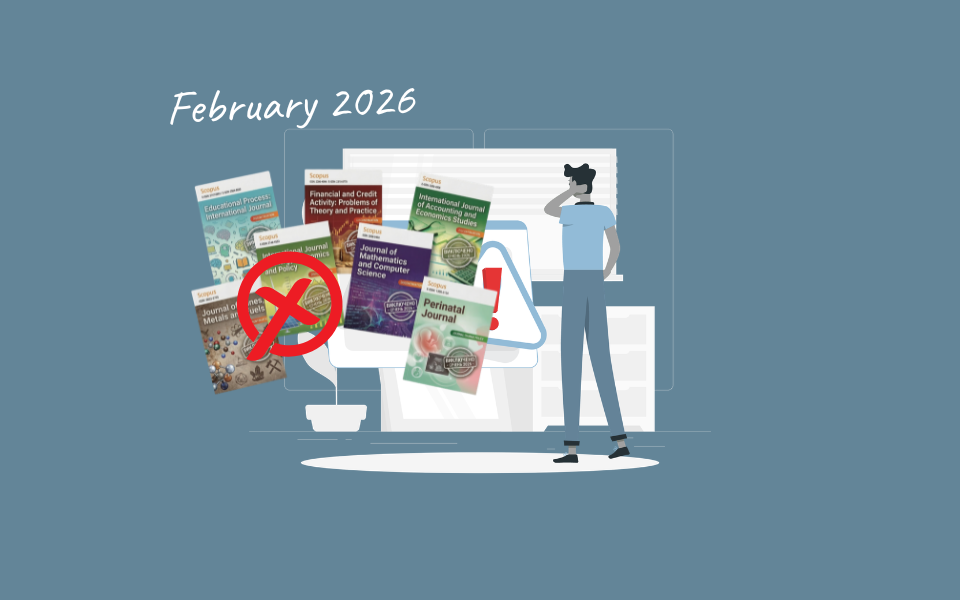
The January 2026 Scopus update brought seven exclusions: five journals received Discontinuation status and two were removed under Journal Change Policy.
The list spans multiple countries and disciplines — from mathematics and medicine to electrochemistry and architecture. One journal, Architecture Image Studies, was previously analysed in our Candidates for Removal from Scopus series, where its exclusion was predicted with 100% certainty.
Below is the full breakdown, including our detailed analysis of the flagged journal.
Before selecting a Scopus-indexed journal, keep in mind: the list of Scopus journals is updated every month. A journal included in the Scopus journal list today may be removed from the Scopus database tomorrow without warning.
In our ongoing series «Candidates for Removal from Scopus», we systematically analyse publications showing early warning signs. This month, Scopus confirmed the removal of a journal covered in our Second Edition:
Architecture Image Studies — full analysis in our Candidates for Removal: Second Edition
Accepted into Scopus in 2024, the journal started showing critical red flags from August 2025: shift to a “multidisciplinary” scope, mass author outreach, and rapid publication of off-topic papers. We assigned it a 100% removal probability.
E-ISSN: 2184-8645 |
Publisher: AP2 (Portugal) |
Reason: Journal Change Policy |
Scopus: View in Scopus | Journal website: journals.ap2.pt |
|
|
Quartile: Q4 Country: Portugal Subject area: Architecture, Design Accepted into Scopus: 2024 Publication fee: from 250 EUR |
|
Architecture Image Studies was accepted into Scopus in 2024 and initially positioned itself as a specialised journal in architecture and design. However, from August 2025 onwards, the journal drastically changed its editorial strategy: mass submission invitations began circulating, and the publication started describing itself as “multidisciplinary” — a term clearly at odds with its own title. Within a short period, a large number of papers with no connection to architecture or design appeared in its pages. This is a textbook sign of a publication that has abandoned academic quality in favour of a commercial model without genuine peer review. |
|
— Publishing papers unrelated to the stated subject area of architecture and design; — Abrupt transition to a “multidisciplinary” scope from August 2025; — Absence of proper peer review; — Rapid growth in publication volume over a short period; — Mass email campaigns inviting authors to submit manuscripts. |
ISSN (Print): 2705-1064
E-ISSN (Online): 2705-1056
Publisher: Universal Wiser Publisher
Reason: Discontinuation
Scopus link: https://www.scopus.com/sourceid/21100830161
ISSN (Print): 2224-0713
E-ISSN (Online): 2307-1419
Publisher: Zaslavsky Publishing House
Reason: Discontinuation
Scopus link: https://www.scopus.com/sourceid/21101212706
ISSN (Print): 2981-0221
E-ISSN (Online): 2981-0213
Publisher: Sami Publishing Company
Reason: Discontinuation
Scopus link: https://www.scopus.com/sourceid/21101176855
ISSN: 1480-2422
Publisher: International Information and Engineering Technology Association
Reason: Journal change policy
Scopus link: https://www.scopus.com/sourceid/25198
E-ISSN (Online): 3049-9011
Publisher: Premier Science
Reason: Discontinuation
Scopus link: https://www.scopus.com/sourceid/21101293002
E-ISSN: 1932-2321
Publisher: Gnedenko Forum
Reason: Discontinuation
Scopus link: https://www.scopus.com/sourceid/21100967049
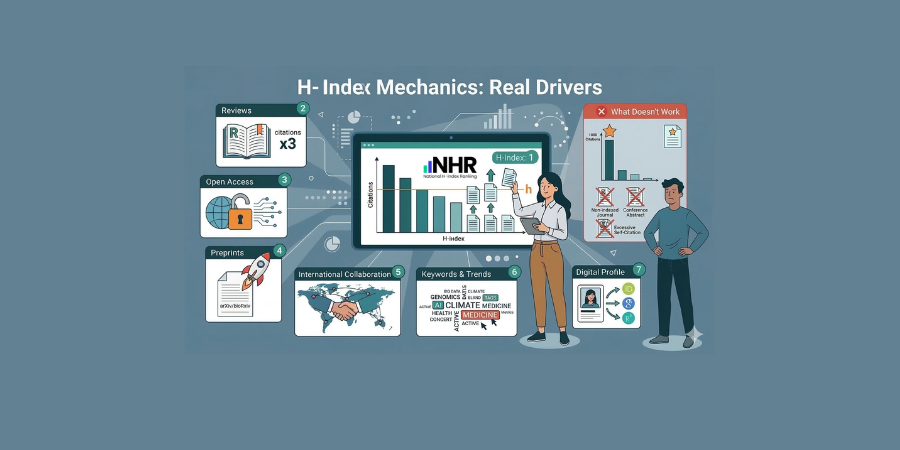
Publishing in Scopus is not only about prestige — it’s about your investment of money, time, and reputation.
The latest Scopus updates once again proved: even well-known journals can suddenly lose their indexing.
That’s why you need experts who check every journal at the moment of submission and provide real guarantees of indexing support.
Choose Futurity Publishing’s service “Journal Selection & Submission Support.”
We will take care of the entire process for you:
✅ Careful journal verification (to avoid discontinued or predatory titles);
✅ Professional manuscript check before submission;
✅ Full guidance until your article is successfully indexed.
No uncertainty. No wasted time.
Only transparent support and guaranteed results.
📩 Send us your request today — and we will match your article with a reliable journal right away.
The January 2026 Scopus update is a clear reminder: indexing is not a permanent feature of any journal — it is a variable that can be revoked at any time.
Seven journals removed this month represent different countries, disciplines, and removal categories. The mix of Discontinuation and Journal Change Policy exclusions reflects two distinct but equally dangerous scenarios for authors. Always verify that a journal is currently indexed in Scopus before submission — the Scopus source list is the only reliable reference:
Discontinuation — the journal has ceased operations; no new articles will be indexed.
Journal Change Policy — the journal altered its editorial direction without notice; Scopus no longer considers it compliant.
For any researcher, de-indexing means the same outcome regardless of cause: the publication does not count towards attestation, academic promotion, or grant applications — and months or years of work may be lost.
The case of Architecture Image Studies illustrates why proactive monitoring matters. By the time Scopus made the removal official, we had already identified the warning signs months earlier — and authors who acted on that analysis avoided the fallout.
Independent journal selection is increasingly a gamble. Without systematic analysis of metrics, editorial behaviour, and publisher history, even experienced researchers fall into traps that cost far more than a publication fee.
Systematic journal analytics is not a recommendation — it is the only real safeguard for your academic results. Work only with experts who verify each journal before submission and stand behind their selection.