How Predatory Journals Trick Researchers — Real Cases and Red Flags

In 2025 alone, predatory journals deceived an estimated 5,000+ researchers worldwide, extracting over $20 million in publication fees. These were not obscure blogs or obvious scam sites. They were Scopus-indexed journals with quartile rankings, professional websites, and active editorial boards — at least on paper.
What happened to those researchers follows a classic, repeatable scheme that has been used successfully for years — and that thousands of researchers fall for every year, precisely because it is designed to look legitimate.
In this article, we break down how the scheme works, show you four real cases from 2025, and explain what signs were visible before each collapse.
How the Trap Is Built: The Classic Predatory Scheme
There are three ways a journal becomes a predatory trap:
Three types of predatory journals
- The established journal that turns. A legitimate journal with years of Scopus history suddenly changes behaviour — it starts publishing at extreme volume, accepting anything, charging high fees. Its existing reputation provides cover during the transition.
- The journal grown for fraud. A new journal is deliberately built to gain Scopus indexation — years of patient, legitimate publishing — and then immediately exploit that status for profit.
- The acquired journal. A journal is purchased by a new publisher with predatory intent. Note: since Scopus now re-evaluates journals when ownership changes, this route carries a higher risk of early detection than it once did.
Once the journal is in position, the scheme unfolds in predictable steps.
Step by step — how researchers get caught
- Aggressive email solicitation. The journal begins mass-mailing researchers with offers of fast publication for a fee. The emails feel urgent and appealing: quick acceptance, Scopus-indexed, affordable pricing.
- The scope question. Some predatory journals stay within their stated scope — lower profit, but lower risk of detection. Others accept papers from any field to maximize revenue. The second type almost always ends in de-indexation.
- The irresistible offer. Researchers under deadline pressure — needing a Scopus publication for a dissertation defense, promotion, or grant — find the offer hard to refuse. The journal is fast. The price is manageable. It looks indexed.
- Submit, accept, publish, pay. The manuscript is accepted within days. The article is published. The researcher pays — typically $300 to $1,500. In some cases, the article is even indexed in Scopus. Everything appears fine.
- Scopus detects the pattern. Scopus operates an automated monitoring system — the Source Quality Radar — that continuously tracks journal behavior. When anomalies are detected, the journal is referred to CSAB (Content Selection & Advisory Board) for a formal review. This process typically takes between 1 and 12 months. If violations are confirmed, the journal is removed from Scopus.
- The consequences vary — but are always damaging. In the most serious cases, all articles from the period of violation are retroactively removed from the Scopus database. In less severe cases, the journal is discontinued and no new articles are indexed, but existing records may remain. Either way, the researcher’s publication loses its Scopus status — permanently.
- The researcher is left to deal with the fallout. The editorial team stops responding. The money is gone. The article’s Scopus record is either deleted or frozen. The researcher must find a legitimate journal, resubmit, and wait months for genuine peer review — while explaining the situation to their institution.
You now know the scheme — time to check your journal.
Get the free Predatory Journal Red Flags Checklist (PDF) via WhatsApp — and evaluate any journal in 5 minutes before you submit.
Four Cases of Predatory Journals in 2025
The following four cases illustrate how the scheme plays out in practice. Each journal operated differently. Each caused real, lasting damage to the researchers who trusted it.
Case #1: International Journal of Innovative Research and Scientific Studies (IJIRSS)
Scopus profile: www.scopus.com/sourceid/21101057630 | Journal website: ijirss.com
What happened: IJIRSS was a model Q2 journal in 2023–2024. In 2025, the pursuit of profit took over. The journal began mass-mailing researchers with fast-publication offers, and the response was overwhelming — within just six months, it had published over 2,000 articles. More than 1,100 of those were indexed in Scopus. Some issues contained over 500 articles each.
The outcome: In September 2025, Scopus removed IJIRSS and deleted all 2025 articles from its database. Thousands of researchers across Indonesia, India, Malaysia, Kazakhstan, Saudi Arabia, and beyond lost their indexed publications. In Kazakhstan alone, more than 1,200 scientists were affected — dissertation defences cancelled, grants revoked, promotions reversed.
What made it convincing: Right up until its removal, IJIRSS displayed legitimate quartile and percentile rankings. There was no obvious external signal that anything was wrong — the warning signs were only visible if you looked at the volume and scope of recent issues.
Case #2: International Journal of Environmental Sciences
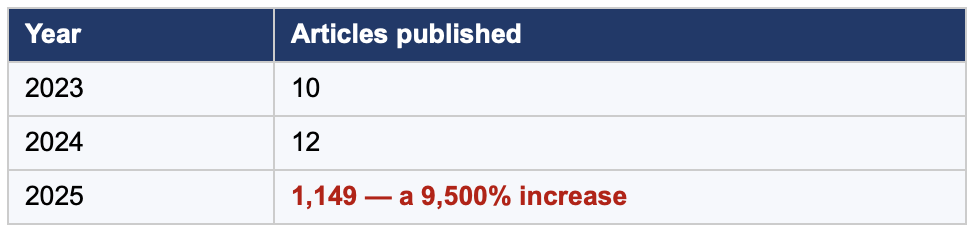
No legitimate journal grows like this. At approximately $700 per article, this single journal extracted an estimated $800,000 from researchers in a single year.
What made it work: The journal published papers from philosophy, machine learning, obstetrics, law, and education — in a journal called ‘Environmental Sciences’. It became a dumping ground for any paper, from any field, as long as the author paid. Researchers who only checked the Scopus status — without reviewing recent issues — had no way of knowing. The most affected countries were India (~500 articles), Indonesia (hundreds of submissions), Iraq, and China.
Case #3: Journal of Cultural Analysis and Social Change
What happened: Scopus discontinued indexing of this journal. Unusually, the articles were not deleted from the database — they remain visible, but the journal no longer carries active Scopus status.
What made this case different: Unlike journals that accelerate suddenly, this one played a longer game. It continued accepting and accumulating manuscripts over an extended period — giving authors the impression of a normal, functioning editorial process. Then, without warning, it published everything in just two issues. Hundreds of papers appeared at once, across healthcare, law, engineering, and education — in a journal whose stated focus was cultural analysis and social change.
Why researchers missed it: The journal’s Scopus status remained active during the period of submission. The editorial process felt slow and professional — exactly what researchers expect from a legitimate journal. The problem only became visible in the published output, not in the process. The largest groups of affected authors came from Indonesia, Saudi Arabia, Malaysia, and Vietnam.
Case #4: Journal of Posthumanism
What happened: In May 2025, Scopus quietly discontinued indexing of the Journal of Posthumanism. The journal’s profile shows it as discontinued, but it was not included in the official Scopus exclusion list for that month — making it extremely difficult for authors to detect the change in time.
Why this matters: The scale of the damage became clear only after the fact: over 1,000 indexed articles were retroactively removed from the Scopus database. Researchers who published there in the months before the cut-off had no standard mechanism to discover that their articles would no longer be indexed — the removal was not announced, and the journal was absent from the official exclusion list. The journal had accepted papers well outside its narrow stated scope — posthumanism — from Saudi Arabia, Indonesia, Jordan, Malaysia, and Vietnam, operating as a volume-driven publication service rather than a genuine academic journal.
Conclusion
Predatory journals do not discriminate. They do not target the naive or the inexperienced. They target anyone with a publication need and a credit card — junior researchers, senior academics, professors with decades ofexperience. The fee is the only selection criterion.
What makes them effective is not sophistication. It is timing. They operate in the gap between when a journal starts behaving badly and when Scopus finishes investigating — a window that can last up to 12 months. Inside that window, thousands of researchers submit, pay, and publish in good faith. By the time the journal is removed, the money is gone, the articles are deleted, and the editorial inbox is silent.
No institution will warn you in advance. No automated system will stop you at the moment of submission. Scopus will eventually act — but eventually is too late for the researchers who already paid.
The cases in this article are not exceptional. They are the pattern. And the pattern repeats every year, at scale, because most researchers only discover how to identify a predatory journal after they have alreadypublished in one.
You now know the scheme — time to check your journal.
Get the free Predatory Journal Red Flags Checklist (PDF) via WhatsApp — and evaluate any journal in 5 minutes before you submit.