The Scopus journal publication timeline can span 6–12 months or longer from submission to publication and indexing. This is a planning scenario, not a standard or guaranteed timeframe: the journal, discipline, manuscript readiness and need for resubmission all affect the duration.
You have completed your research, prepared your manuscript, and found a journal. Your grant report or academic review is six months away. That seems like enough time.
But the first journal rejects the paper because it falls outside its scope. The next struggles to find reviewers. Peer review leads to substantial revisions. Your deadline approaches, and you still have no final decision.
Authors cannot control every editorial decision. They can, however, account for common sources of delay before submitting—starting with journal selection.
Scopus is a database that indexes scholarly content. The journal’s editorial team evaluates your manuscript, not Scopus.
For planning purposes, distinguish between three stages:
An acceptance letter does not mean the entire process is complete. If you need a Scopus record by a specific date, your schedule must account for every stage.
For context, Springer Nature’s guidance on publication times notes that peer review of a full research article can typically take 3–6 months, with reviewer availability affecting the duration. This publisher-specific guidance is not a universal timeline for every Scopus-indexed journal.
Elsevier’s Scopus indexing guidance says articles are usually indexed within four days after Scopus receives them. That interval starts at receipt by Scopus—not at manuscript submission, acceptance or necessarily the publication date.
Editors need to find specialists who can assess the research and are willing to review it. Reviewer feedback may require additional analysis or substantial changes to the manuscript. A revised paper may then need another round of assessment.
Rejection adds a different delay: the author must select another journal, check its requirements, and prepare a new submission. A schedule that assumes acceptance at the first journal is therefore particularly vulnerable.
A practical approach is to identify a primary journal and several alternatives in advance. These are options for sequential submission: move to the next journal only after the previous review process has ended or withdrawal has been confirmed.
Start with a question: who needs the findings of your research?
Read the journal’s aims and scope and several recent articles. Consider the research questions, methods, and readership. Sharing a broad subject area does not necessarily mean that a manuscript fits the journal’s editorial priorities.
Create a short comparison for each candidate:
| What to Check | Why It Matters |
| Scope and accepted article types | Assess whether your manuscript fits |
| Time to first decision | Plan for the initial waiting period |
| Time from acceptance to publication | Account for the production stage |
| Article processing charge—APC | Confirm your budget in advance |
| Language and formatting requirements | Estimate the preparation required |
Check what published timelines actually measure. A first decision may be a request for revisions; it is not equivalent to acceptance. An average turnaround time is also not a promise for an individual manuscript.
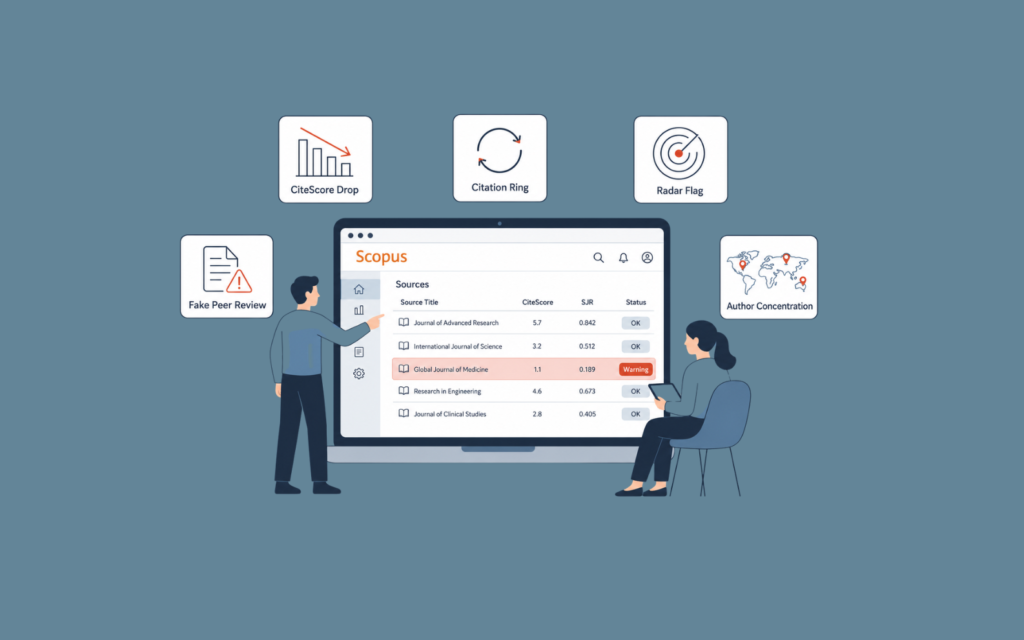
Check the journal’s title, ISSN, and coverage period against official Scopus information. Also check whether its coverage has been discontinued. Use the source lists available through Elsevier.
Save the date of your check and the source link. If the review process takes a long time, check the status again: information that was current at submission may change.
For practical examples of journal-selection risks, read our guide to high-risk Scopus journals in 2026 and our overview of warning signs of Scopus journal exclusion. Use these checks alongside official coverage information when building your shortlist.
First, establish what you need by the required date: an acceptance letter, a published article, or a record in Scopus. Confirm this with your institution or the organization receiving your report.
Then allow time for each necessary stage, your own revisions, and a possible resubmission. This approach helps reveal scheduling risks before the manuscript reaches an editor.
Publishing in a Scopus-indexed journal can take 6–12 months or longer. The overall timeline includes several stages, and resubmission after rejection can extend it further.
To reduce the risk of delays, assess how well the journal fits your research, clarify its timelines, and allow room for revisions. An informed journal choice can help prevent avoidable delays before your first submission.