5 Warning Signs Your Scopus Journal Will Be Excluded in 2026

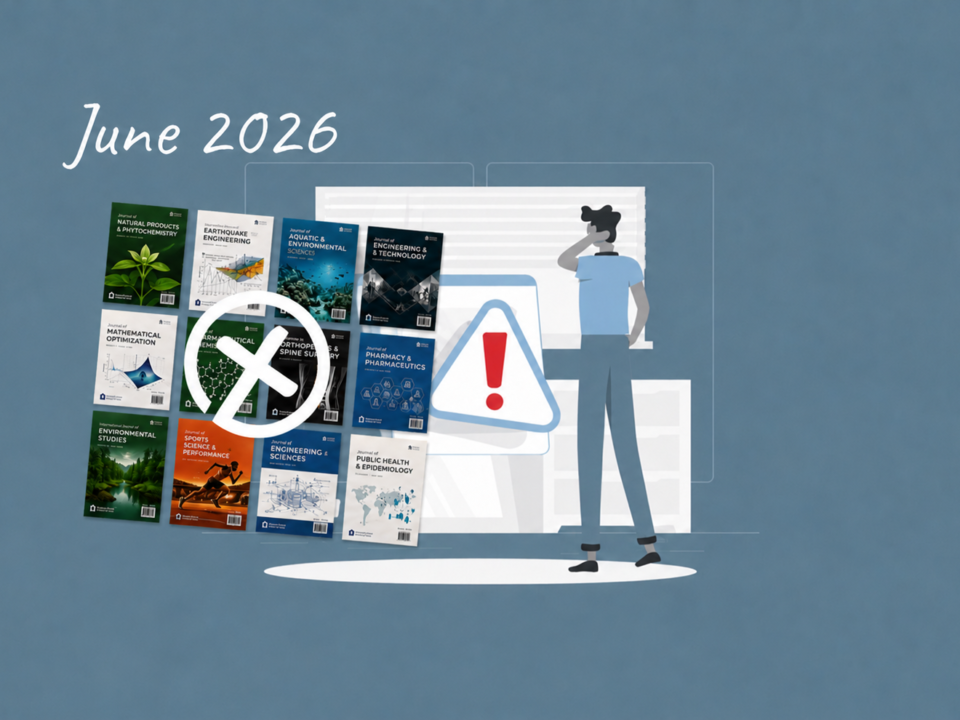
In 2025, Scopus removed 56 journals from its index. The pace hasn’t slowed in 2026 — 25 more titles were discontinued in the May/June update alone, including two journals published by Elsevier itself: Alexandria Engineering Journal and Case Studies in Thermal Engineering. Both had been indexed for years. Neither came with a public explanation.
If you’re publishing in a Scopus-indexed journal to defend a PhD, satisfy a grant requirement, or qualify for a promotion, a Scopus journal exclusion isn’t a distant risk. It’s a monthly event, and it increasingly happens to journals that looked completely safe twelve months earlier. This article walks through how Scopus actually decides which journals to cut, and the five warning signs you can check yourself — before you submit, and long before a defense committee asks why your journal disappeared from the index.
How Scopus Actually Decides to Remove a Journal
Every journal indexed in Scopus is evaluated by the Content Selection and Advisory Board (CSAB), an international panel of scientists and librarians. Elsevier follows CSAB’s recommendations but reserves the right to act on any title without prior notice. Four separate pathways can trigger a review:
Annual benchmark failure. Every journal is measured once a year against six quantitative metrics compared to its subject-field peers. A journal has to fail all six for two consecutive years before CSAB opens a formal review — the first year of failure only generates an internal pre-warning that authors never see.
Radar anomaly detection. Elsevier’s automated system scans every journal quarterly for irregular citation and publication patterns. A Radar flag goes straight to CSAB review, with no warning period at all.
External reports. Researchers, institutions, or watchdog groups can report concerns directly. A validated report bypasses the warning stage entirely.
Continuous editorial review. CSAB also runs independent, ongoing assessments that aren’t tied to any specific trigger.
Since late 2024, Scopus has folded most of its specific reason codes — “Radar,” “Publication Concerns,” “Outlier Behaviour” — into the single, less informative label “Discontinuation.” That makes it harder for authors to work out why a journal was cut, which is exactly why knowing the underlying signals matters.
For the full breakdown of every criterion CSAB actually applies, see our detailed guide: How Scopus Decides to Remove a Journal — Real Criteria
The six official annual benchmarks, each measured against the journal’s subject-field average:
| Metric | Failing Threshold |
|---|---|
| Self-citations | 200%+ above field peers |
| Total citations | Below 50% of field average |
| Impact Per Publication (IPP) | Below 50% of field average |
| Article output | Below 50% of field average |
| Abstract usage | Below 50% of field average |
| Full-text link clicks | Below 50% of field average |
A journal has to fail every one of these, two years running, for the annual pathway to trigger a review — but Radar and external reports don’t wait that long.
Warning Sign 1: Citation Metrics Declining for Two Years Straight
This is the slow-moving version of risk, and it’s the easiest to spot in advance. If a journal’s CiteScore or SJR has been dropping relative to its field for two consecutive years — particularly a slide from Q2 into Q3 — it’s already inside the annual benchmark review window.
A 2020 peer-reviewed analysis of 317 journals discontinued for “Publication Concerns” found their median SJR at the point of removal was just 0.17, placing most of them solidly in Q3–Q4 territory. The same study found journals published by non-university presses were roughly eleven times more likely to be discontinued than university-affiliated journals.
What to check before submitting:
- CiteScore and SJR trend over the last 3 years, not just the current value;
- Whether the journal’s percentile has fallen below the 25th–35th range — the exact bracket several national defense committees now use as a minimum threshold;
- Whether the decline is journal-specific or reflects a field-wide trend (context matters).
Warning Sign 2: Abnormal Self-Citation and Citation Manipulation
Radar’s most sensitive trigger is self-citation running at 200% or more above the field average. If comparable journals in a discipline self-cite at roughly 10%, a journal sitting at 20%+ gets flagged automatically — and a Radar flag skips the warning period entirely.
In August 2025, eight journals — including four titles from the Minerva Medica group — were removed simultaneously under the label “Outlier Behaviour.” The pattern behind that label: unnatural citation spikes, coordinated cross-citation between closely related titles, and self-citation far outside normal range.
What to check:
- Whether editors have “suggested” you cite specific journal articles during revision — a documented form of coercive citation;
- Unexplained spikes in a journal’s total citation count with no corresponding rise in readership;
- Clusters of two or three journals that consistently cite each other far more than the rest of the field.
Warning Sign 3: Sudden Publication Volume Growth
Radar’s second major signal is a rapid, unexplained jump in article output — and since 2022, the dominant vector for this has been special issue abuse. A journal that normally runs 5–10 articles per issue suddenly publishing 50+, or announcing a wave of special issues in quick succession, is a documented paper-mill entry point.
Clarivate removed roughly 50 Hindawi/Wiley journals in 2023 for exactly this reason, after its AI-assisted review flagged more than 500 titles in a single cycle. A related but separate signal is review speed: independent analysis of health-policy journals found a median peer review time of 60.5 days, which makes any journal promising a decision in under a week statistically implausible — and a near-universal marker of a predatory or compromised title.
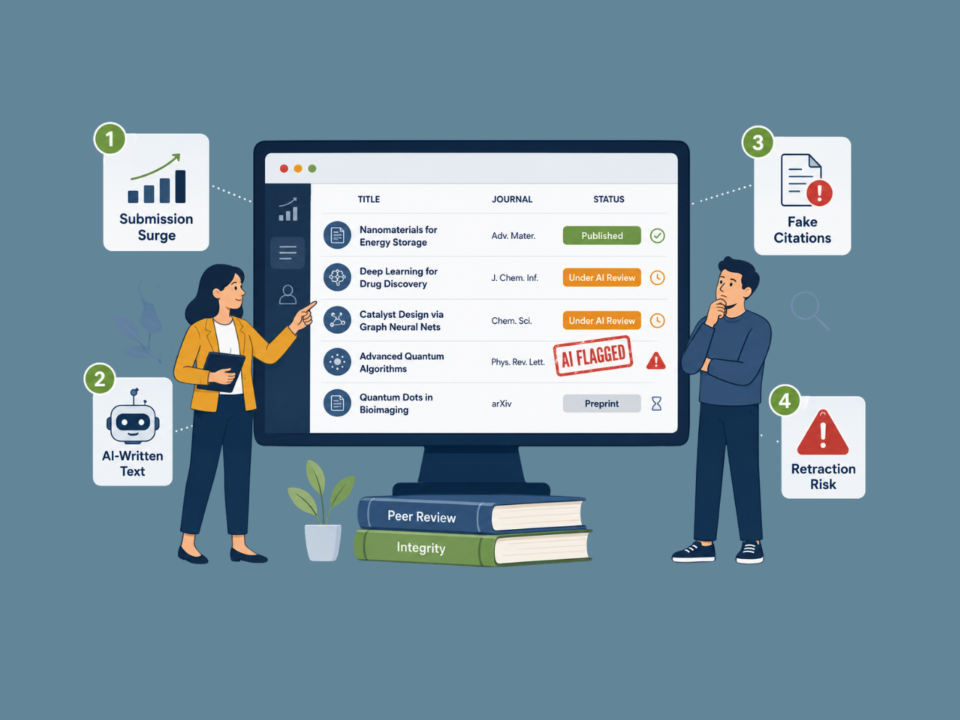
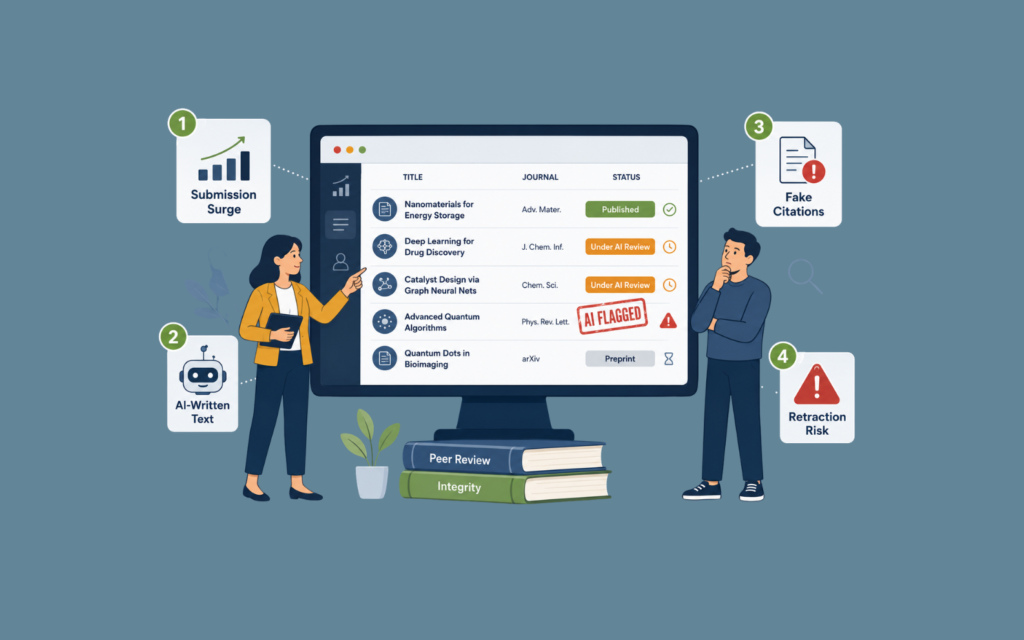
Part of the pressure behind special-issue overuse is demand-side: submission volume has surged industry-wide, driven in large part by AI-assisted writing. We cover that shift in 50% More Competitors for Every Journal Slot — How AI Changed Academic Publishing Against You — worth reading if you’re wondering why review queues feel longer than they used to.
What to check:
- Year-on-year article count growth above 100% with no obvious field-wide cause;
- A cluster of special issues announced in a short window, especially with guest editors who have thin publication records;
- Review-to-decision timelines advertised as under two weeks.
Warning Sign 4: Editorial Board Red Flags
CSAB explicitly requires broad geographic distribution and demonstrated academic standing among a journal’s editors. Radar separately monitors for sudden, unexplainable shifts in author and editor geography.
The starkest documented case is Science of Law, accepted into Scopus in July 2024 and removed in May 2025 after a Retraction Watch investigation found that all 60+ listed editorial board members were fabricated — none appeared in any academic directory. Elsevier took the unusual step of removing the journal’s entire back catalog, not just halting future coverage.
This isn’t an isolated tactic — for more documented cases of exactly how fabricated boards and fake credentials get used to mislead authors, see How Predatory Journals Trick Researchers — Real Cases and Red Flags
What to check before you trust an editorial board:
- Spot-check 3–5 board members against their listed institution’s faculty directory and their Scopus author profile;
- Watch for heavy concentration of editors from a single country or region with no stated rationale;
- Note any recent change of publisher or ownership — this alone now triggers CSAB re-evaluation as of a 2024 policy update.
Warning Sign 5: Retraction Spikes and "On Hold" Status
Retraction spikes matter here, but not the way most people assume. Clarivate’s own 2026 guidance is explicit that journals aren’t penalized for retracting papers — in fact, retracting flawed work is treated as evidence of a functioning editorial process. The actual red flag is what happens after: problems that surface on PubPeer or Retraction Watch and are never addressed, or a pattern of retractions that points to systemic failure rather than isolated error.
Web of Science has a parallel mechanism: journals placed “On Hold” while under review. Clarivate data shows roughly 85% of held journals are ultimately delisted, with most holds resolving within about six weeks. A hold in Web of Science is one of the strongest available leading indicators that a Scopus review may not be far behind.
What to check:
- Search the journal name on PubPeer and Retraction Watch for unresolved allegations;
- Check the journal’s current status on the Web of Science Master Journal List for an active hold;
- Look for a pattern of retractions concentrated around a specific editor, guest-editor cluster, or special issue.
📋 Free Checklis
A safe journal isn’t the only thing standing between you and publication — the manuscript itself gets screened first. Editors reject most submissions before a single reviewer ever sees them.
What Exclusion Actually Means for Your Publication
Papers already indexed at the time of publication generally remain part of the scientific record — they don’t vanish from Scopus retroactively in most cases. But there are real exceptions: Elsevier has fully removed a journal’s entire back catalog in confirmed cases of serious misconduct, and some discontinued journals are quietly relabeled as “indexed only up to year X” without ever appearing on the official discontinuation list.
For PhD candidates, the more immediate risk is timing. A journal can look fully active on its own website while it’s already under CSAB review, because content suspension is only visible to someone checking the Scopus source record directly. Several national defense frameworks now require a minimum CiteScore percentile (commonly 25th–35th) at the time of submission, and that threshold can shift while your manuscript is still under review. Grant bodies and institutional rankings that count Scopus output face the same exposure.
If any of the signs above apply to your target journal, it’s worth lining up a safer alternative before you submit rather than after. Our guide How to Find a Q1–Q2 Scopus Journal That Actually Accepts Your Paper walks through exactly that process.
Conclusion
None of this means every journal is a risk, and it doesn’t mean the system is broken — CSAB removed problem journals long before paper mills became a global concern, and the pace of removals in 2025–2026 largely reflects a genuine surge in bad-faith publishing rather than Scopus turning on legitimate research. What it does mean is that “currently indexed” is not the same as “safe for the next twelve months,” and the five signs above are the fastest way to tell the difference before you commit a manuscript, a defense timeline, or a grant deliverable to a single journal.
Running that check on your own is entirely doable with the signs above — it just takes time most researchers don’t have while they’re also writing the paper itself. A structured risk report can help you take the next step before submitting.