How Scopus Decides to Remove a Journal — Real Criteria

Most researchers treat Scopus indexing as a stable signal. If a journal appears in the database, it must be safe to publish there. This assumption is wrong — and increasingly costly.
In 2025 alone, Scopus discontinued 56 journals. Some of them had been indexed for over a decade. Some were published by major international houses. Some held Q2 status with strong percentile rankings until the moment they were removed.
Understanding how Scopus actually makes these decisions is not just useful. For anyone preparing a dissertation defence, seeking academic promotion, or managing a publication strategy, it is essential.
If you are still in the process of choosing where to submit, see our guide on how to find a Q1–Q2 Scopus journal that actually accepts your paper.
Who Makes the Decision: The CSAB
Scopus does not remove journals arbitrarily. All inclusion and removal decisions are made by the Content Selection and Advisory Board (CSAB) — an internationally composed group of scientists, researchers, and librarians. The board includes 17 Subject Chairs, each responsible for a specific academic domain.
Elsevier formally states it follows independent CSAB advice. At the same time, Elsevier explicitly reserves the right to remove or re-evaluate any title without prior notice — and has exercised this right in documented cases. For context on how this evaluation process works at the acceptance stage, see how Scopus evaluates and accepts journals.
Four Pathways That Trigger Re-Evaluation
A journal does not end up under review by accident. There are four distinct mechanisms:
1. Underperformance on Annual Quantitative Benchmarks
Every indexed journal is measured annually against three relative metrics, compared to peer journals in the same subject field:
- Self-citation rate must not be substantially higher than field peers
- Total citation rate must not be substantially lower than field peers
- CiteScore must not be substantially lower than field peers
If a journal fails all three benchmarks for two consecutive years, it is automatically escalated to CSAB re-evaluation. Failing in year one triggers a pre-warning; failing to improve by year two triggers a full review.
2. Radar — Automated Anomaly Detection
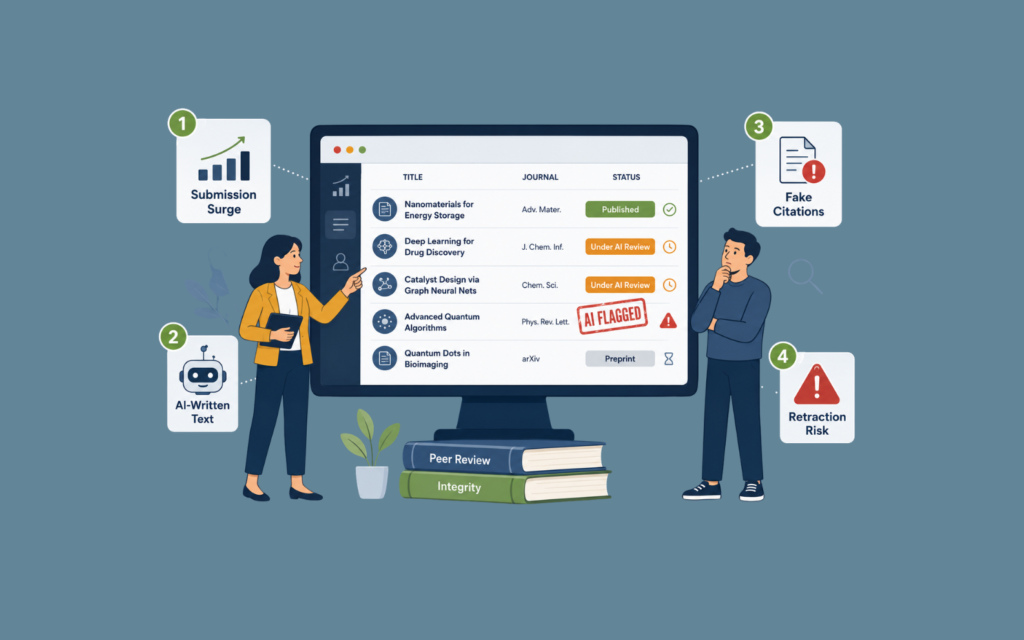
Since 2017, Elsevier has operated a proprietary algorithm called Radar that scans all indexed journals on a quarterly basis — not just annually. Radar monitors for signals including:
- Sudden, unexplained surges in article volume
- Self-citation rates exceeding 200% compared to similar journals in the field
- Coordinated mutual citation rings between journals
- Unexplained shifts in geographic author concentration
- Coercion of authors to cite editorial board members
- Acceptance patterns inconsistent with genuine peer review
- Abrupt scope shifts
- Abnormally low abstract and full-text access rates
When Radar flags a journal, it proceeds directly to CSAB review — there is no warning window.
3. Publication Concerns Raised Externally
The research community, publishers, institutions, and individual academics can formally report concerns to Scopus. Validated reports also bypass the warning stage and go directly to CSAB review.
4. Continuous Curation by the CSAB
The board conducts ongoing editorial review independent of the other three pathways. Journals can be flagged for future re-assessment at any point.
The Re-Evaluation Process: What Actually Happens
Metric-based cases receive a pre-warning. The publisher is notified of which benchmarks were not met and given one year to show improvement in at least one metric. If no improvement occurs, a full CSAB re-evaluation follows.
Radar and publication concern cases receive no warning period. They enter the pipeline immediately.
Once a journal is under formal re-evaluation:
- Content flow is suspended — no new articles are indexed during the review period. This is one of the earliest observable signals.
- The CSAB evaluates the journal against the same five criteria used for all new title submissions: journal policy, content quality, journal standing, publishing regularity, and online availability.
- The board requests relevant information from the publisher.
The outcome is one of three:
| Outcome | Meaning |
|---|---|
| Continue | Coverage resumes |
| Monitor | Journal continues but faces mandatory re-review in 12 months |
| Discontinue | New content indexing is permanently halted |
A discontinued journal cannot re-apply for Scopus indexing for five years.
Previously indexed content generally remains in Scopus as part of the scientific record. However, in cases of severe, proven misconduct, Elsevier has removed all previously indexed content — as occurred in 2025 with the Science of Law journal, where fabricated editorial board members and falsified publication history were confirmed.
What "Publication Concerns" Actually Means
“Publication Concerns” is the most frequently cited reason for discontinuation across all years. In practice, it covers a specific set of documented violations:
- Absence of genuine peer review — articles accepted without substantive editorial evaluation
- Citation manipulation — inflated self-citation, editorial board coercion, coordinated citation rings
- Plagiarism and self-plagiarism at scale
- Fabricated editorial infrastructure — non-existent or fake board members
- Scope mismatch — consistent publication of content outside the stated subject area
- Abnormal article volume growth
- Predatory fee-seeking without legitimate editorial services
- Aggressive mass solicitation of manuscripts
- Misrepresentation of indexing status or credential
Research data: Analysis of 317 journals discontinued for Publication Concerns found that over 60% were removed for poor editorial practices, including predatory behaviour. Non-university publishers wereapproximately 11 times more likely to be discontinued than university publishers. Median SJR at the time of discontinuation was 0.17 — placing most removed journals in Q3 or Q4.
What the Data Shows: 2022–2025 Removal Patterns
The pace of removals has increased. In March 2023, the cumulative total of discontinued titles since Scopus launched stood at 782. By the end of 2025, 56 titles had been removed in that year alone — with monthly updates averaging 7 to 12 removals.
Several patterns are consistent across this period:
Publisher-cluster removals are increasing
When one journal from a publisher is flagged, others from the same house frequently appear in the same or subsequent update cycles. Multiple titles from the same Indonesian publisher were removed in a single March 2025 update.
Long-indexed journals are not immune
Journals with 10 to 15 years of indexing history have been discontinued. Length of indexing provides no protection if editorial standards deteriorate.
Radar and Outlier Behaviour designations are becoming dominant
In 2024–2025, automated detection flagged an increasing share of removed titles — including journals published by Elsevier itself.
The terminology is becoming less informative
As of 2025–2026, Scopus has been replacing specific reason labels (Publication Concerns, Radar, Outlier Behaviour) with broader terms such as “Discontinuation.” This reduces visibility for authors trying to assess why a journal was removed.
Warning vs. Full Removal: The Practical Difference
The key distinction is whether the trigger involves metric underperformance or proven misconduct.
Metric underperformance typically generates a warning and a 12-month improvement window. The journal continues to be indexed during this period.
Radar detection, confirmed publication concerns, or outlier behaviour patterns skip the warning stage entirely. Content indexing is suspended immediately upon entering CSAB review.
For authors, this distinction matters for a practical reason: a journal can appear active and indexed while simultaneously being under review. The suspension of content flow is visible in the Scopus source record — but it requires knowing where to look.
| Dimension | Detail |
|---|---|
| Trigger: Warning | Fails one or more annual benchmarks but not all three for two consecutive years |
| Trigger: Full removal | Fails all benchmarks for 2 consecutive years; OR validated publication concerns or outlier behaviour confirmed by CSAB |
| Content flow | Continues during warning period; suspended immediately upon formal CSAB review |
| Improvement window | One year for metric cases; no window for publication concern / Radar cases |
| Re-application embargo | 5-year embargo after discontinuation |
| Previously indexed content | Remains indexed in Scopus (exceptional total removal for severe ethics violations only) |
For a wider perspective on how researchers are misled before these signals become visible, see how researchers get misled by journals that are ‘supposedly’ indexed in Scopus.
Conclusion
Scopus journal removal is a structured, criteria-based process — not an unpredictable event. The CSAB applies consistent evaluation standards. Radar monitors every indexed journal every quarter. Publication concerns can be reported by anyone in the research community.
What makes journals vulnerable is always the same set of factors: editorial shortcuts, metric manipulation, scope drift, and predatory volume growth. These do not appear suddenly. They develop over time and leave observable signals before the removal decision is made.
For researchers and institutions, the implication is straightforward: formal indexing status is a starting point for journal evaluation, not the conclusion of it. The question is not only whether a journal is in Scopus today — but whether it will still be there when it matters.
If you are currently planning your publication timeline, the guide on how long it really takes to publish in Scopus Q1–Q2 provides realistic benchmarks for planning ahead.
Not sure how to evaluate a specific journal before submitting?
We put together a 7-Point Red Flags Checklist — How to Spot a Journal at Risk based on the exact criteria Scopus and CSAB use to flag and remove journals.
It covers the signals that precede most removals — the ones that are visible before a decision is made.