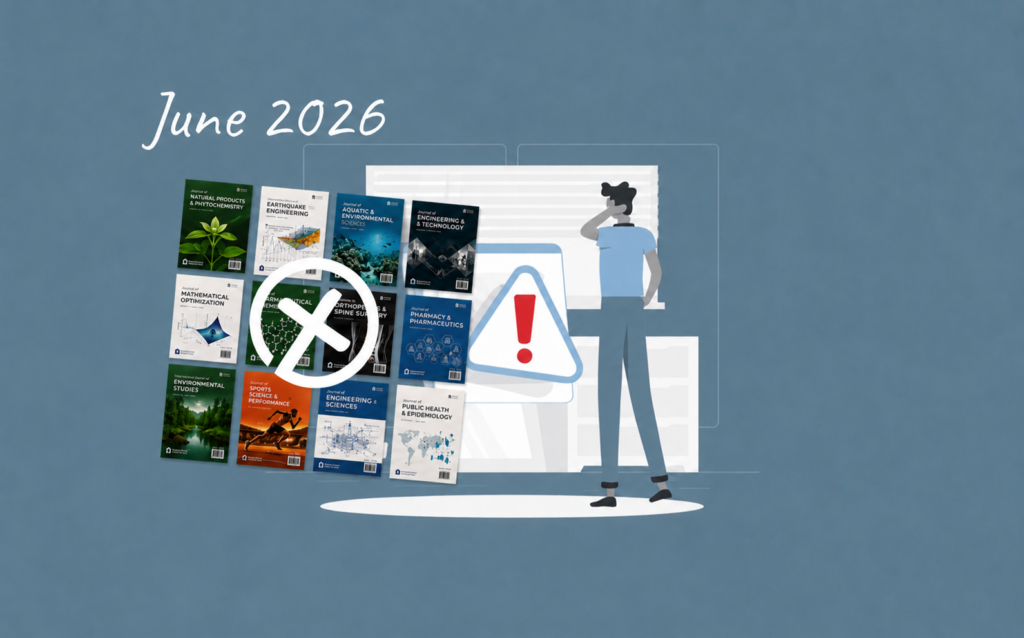
Candidates for Removal from Scopus: Fourth Edition

My name is Vasyl Malets, Director of Futurity Publishing and author of the analytical series “Journals That May Lose Scopus Indexing”.
This is our second issue of 2026 — and it turned out to be a particularly revealing one. This time, our list includes four journals across different quartiles. And the most uncomfortable finding: two of them are Q1.
Yes, Q1. The quartile most researchers trust without asking too many questions. Today’s issue is a reminder that quartile reflects a journal’s past — not its current behavior.
In this issue, we cover:
- 1 Q3 journal that became a full-scale publishing factory — 16 issues in a few months instead of 4 per year;
- 1 brand-new Scopus journal that started sending mass “fast publication for any topic” invitations almost immediately after indexing;
- 2 Q1 journals — because, unfortunately, a high quartile is no longer a safety guarantee, and this issue proves it.
Unfortunately, none of the journals in today’s list represent isolated mistakes. What we’re seeing is a pattern: mass publication without proper peer review, systematic disregard for academic standards, and editorial models built around revenue — not research.
These journals most often lead to:
- wasted time and money for authors;
- problems with publication recognition and academic reporting;
- a high risk that the journal will be removed from Scopus in the near future.
In this article, we break down each journal, explain the key red flags authors should recognize, and why publishing in such outlets in 2026 is — as we like to say — high-stakes roulette where the house always wins.
List of journals
ISSN: 0975-4415
🔗 Scopus: https://www.scopus.com/sourceid/20500195212
🔗 Journal website: https://ijddt.com/
🔗 SCImago: https://www.scimagojr.com/journalsearch.php?q=20500195212&tip=sid
Overview: IJDDT has been indexed in Scopus since 2014. For over a decade, it published exclusively within its stated aims and scope — pharmaceutical science, drug delivery, 4 issues per year. Then, within just a few months of 2026, something shifted dramatically.
The journal has already released 16 (!) issues in early 2026 — compared to its standard 4 per year. Each issue contains approximately 100 articles. But it’s not just the volume that’s alarming. The content has moved far beyond pharmaceutical science: agriculture, education, business, law — practically anything goes.
Main conclusion: The journal now behaves like a “catch-all multidisciplinary dump with a pharmaceutical label”. Its declared scope is narrow (drug delivery) — its actual content is wide-ranging chaos. The gap between what’s claimed and what’s published is critical.
Journal profile:
- Quartile: Q3
- Country: India
- Subject area: Pharmaceutical Science, Drug Delivery
- APC (Article Processing Charge): 1,800 USD
Key violations:
- 100+ articles per issue — this is no longer a journal, it’s a conveyor belt 🏭;
- “11s”, “12s” type issues — bulk loading via Special Issue Factory format;
- Off-topic articles (outside pharma) make up the majority of recent issues;
- Accepting virtually any submission regardless of topic relevance.
Risk assessment:
- Probability of Scopus removal: 100%
- Probability of deindexation of already published articles: 95%
E-ISSN: 2582-7472
🔗 Scopus: https://www.scopus.com/sourceid/21101365669
🔗 Journal website: https://www.granthaalayahpublication.org/Arts-Journal/index.php/ShodhKosh
Overview: This journal entered Scopus recently and hasn’t yet accumulated a large number of articles. But it has already launched a wave of mass invitations promising fast publication of “any manuscript on any topic”.
The name suggests a focused arts journal. Open the actual content and the picture is different: articles with no connection to visual or performing arts are already appearing, the scope is so vague it covers almost anything. The editorial logic is clear: “If it mentions media, culture, or cinema — accept. If not — accept anyway 🙂”.
This is a textbook “multidisciplinary dump” operating under an arts journal label. Heavily inflated issues are predictable within the coming months — the early signs are already unmistakable.
Journal profile:
- Quartile: Not yet assigned (new Scopus journal)
- Country: India
- Subject area: Visual and Performing Arts
- APC: 800 USD
Key violations:
- Articles unrelated to arts are already present;
- Scope is excessively broad — effectively unlimited;
- Volume clearly prioritized over quality and thematic coherence;
- Mass “fast publication” invitations — a classic predatory practice signal.
Risk assessment:
- Probability of Scopus removal: 100%
- Probability of deindexation of existing articles: 95%
ISSN: 1981-6472
🔗 Scopus: https://www.scopus.com/sourceid/21100790313
🔗 Journal website: https://ojs.interpersonajournal.com/index.php/ojs/index
🔗 SCImago: https://www.scimagojr.com/journalsearch.php?q=21100790313&tip=sid
Overview: This one is Q1 — and that’s exactly why it deserves special attention. Because Q1 no longer automatically means “safe”. This case is one of the clearest illustrations of how that assumption fails.
Interpersona has existed for years as a legitimate academic journal focused on interpersonal relationships. Then it changed publishers — moving to a Brazilian organization called GATE — and things started getting unusual quite quickly.
The journal’s scope is written in a brilliantly vague way 😄 — “human relationships in any sphere of life”. This effectively permits psychology, business, law, biology — and practically anything else. In practice, the journal is already circulating fast-publication-for-payment invitations with no meaningful peer review.
We covered a near-identical case previously — the Journal of Cultural Analysis (Part 12 of this series). The pattern is exactly the same.
Journal profile:
- Quartile: Q1 (Cultural Studies)
- Country: Brazil (new publisher since 2025)
- Subject area: Interpersonal Relationships
- APC: 2,000 USD
Key violations:
- Publisher change → complete overhaul of editorial policy;
- Scope functions as a “rubber band” — fits virtually any discipline;
- Articles without a clear interpersonal focus are already appearing;
- Paid fast-track publication with no meaningful peer review.
Risk assessment:
- Probability of Scopus removal: High
- Probability of article deindexation: High — the Q1 label conceals a deeply problematic editorial practice
⚠️ Key takeaway for authors: This is a textbook case of a journal that still holds Q1 status on paper, but by every behavioral and editorial indicator is already in the critical risk zone. Publishing here in 2026 is a serious bet against your own academic reputation.
ISSN: 2231-6094
🔗 Scopus: https://www.scopus.com/sourceid/21101180700
🔗 Journal website: https://ojs.trp.org.in/index.php/ijiss/index
🔗 SCImago: https://www.scimagojr.com/journalsearch.php?q=21101180700&tip=sid
Overview: Another Q1 — and arguably the most alarming case in this issue, because the scale of scope violations here is exceptional.
The journal declares a focus on Library and Information Sciences (LIS). Indexed in Scopus since 2023. But open the actual issues and you’ll find an entirely different reality.
Recent volumes contain articles on: tourism and hospitality, marketing and finance (CAPM, crowdfunding), HR and personnel management, constitutional law and Qisas, AI in cardiology, psychology, sociology, agriculture, and blockchain in the fashion industry. This is not 2–3 edge cases. This is systematic. Over 50% of articles fall outside core LIS.
Main conclusion: The journal “plays the role of LIS — but operates as a multidisciplinary factory”. This is a textbook example of what a journal looks like just before Scopus takes action.
Journal profile:
- Quartile: Q1 (Library and Information Sciences)
- Country: India
- Subject area: Library Science, Information Systems
- APC: 1,250 USD
Key violations:
- 50%+ of articles fall outside core LIS;
- Extremely heterogeneous content with no disciplinary logic;
- Steadily growing article volume per issue;
- Oversized issues with hundreds of articles per volume;
- Complete absence of thematic consistency.
Risk assessment:
- Probability of Scopus removal: 90%
- Probability of deindexation of existing articles: 30–50%
🔒 DON'T SUBMIT BEFORE CHECKING YOUR JOURNAL
Every journal in today’s list showed warning signs long before any official Scopus action was taken — a sudden spike in article volume, off-topic content creeping in, editorial policy shifts. These patterns are visible if you know what to look for.
Use our free 7-point Red Flags Checklist to verify any journal in under 5 minutes — before it’s too late.
Conclusion
This issue covered four journals from across the quartile spectrum — from an unranked newcomer to Q1. That variety is not coincidental. It confirms one simple truth:
neither quartile nor Scopus presence alone guarantees safe publication.
Even highly-ranked journals can drift from their academic mission and shift to revenue-first models. That’s exactly what’s happening with Interpersona and IJISS right now — both Q1, both already exhibiting the signs Scopus will eventually act on.
The authors who fall into these traps most often are those who needed a quick publication and skipped the analysis: journal behavior, publication volume trends, actual Aims & Scope compliance. The outcome is almost always the same — lost money, lost time, and recognition problems down the line.
That’s why, before submitting, it’s worth slowing down and checking a journal comprehensively — or working with specialists who deal with publications daily and understand where the real risks lie. A fast decision almost always costs more than a careful, verified one.
This was Vasyl Malets
Scientometrics expert and founder of Futurity Research Publishing.
Follow me on LinkedIn
You’ll find even more valuable insights about academic journals and publications there.

Compare these risk candidates with confirmed 2026 removals in Arxivia’s April–May Scopus delisting report and its June 2026 update covering 12 more journals.
Researchers in India, Pakistan, Nigeria, Indonesia and Vietnam can use Arxivia’s predatory journal checker and Scopus risk analyzer before paying an APC or submitting a manuscript.